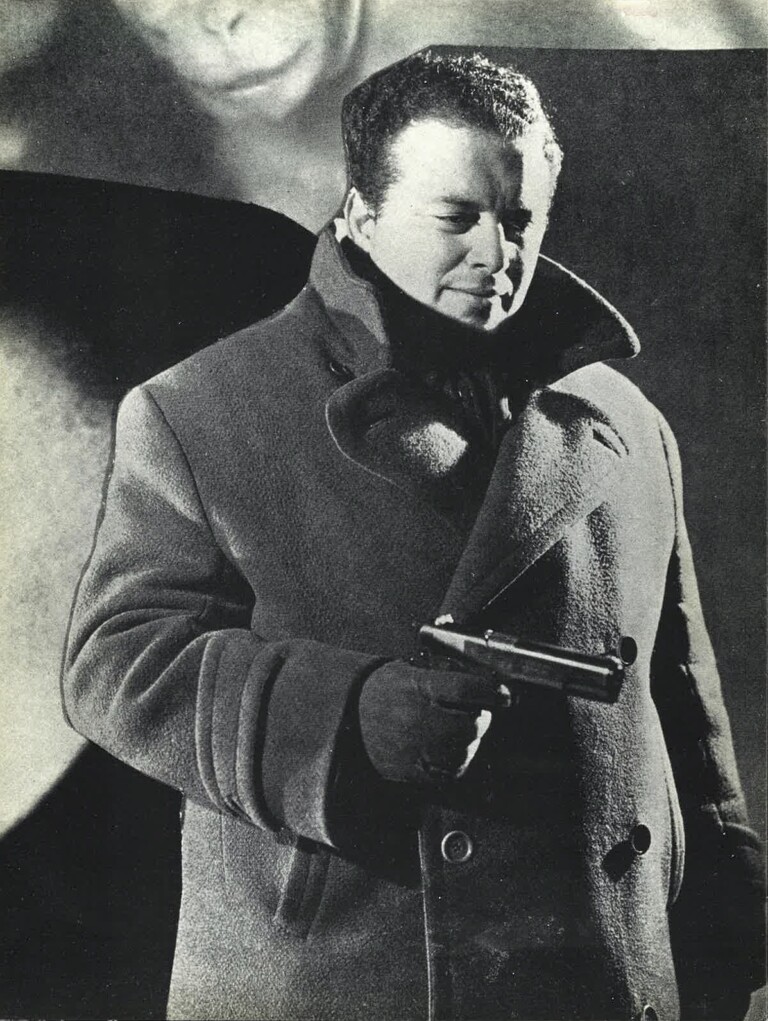
In his two autobiographies, his books, his newspaper articles, and in conversation, he presented himself in turn as the bodyguard of Al Capone, the seducer of a fashionable actress while he was still only a teenager, an arms-smuggling trafficker in China, a general during the Spanish War, a friend of the royal family, an adviser to famous statesmen, the mysterious writer E. Traven, and claimed to have traveled around the world in a small boat.
All of this was told with such conviction that he himself believed it.
But Jack’s sincerity can be found when it comes to his work. Jack began painting in London in 1939, and his first exhibition took place that same year. The second exhibition was held in 1940 at the Zwemmer Gallery. During his internment in 1940 he continued to draw and used the paper that served for the blackout as a substitute for canvas. His first exhibition caused a sensation; the public was stunned by the “strength” of his painting.
He opened the Modern Art Gallery on October 2, 1941. The general opinion was that it was madness. Bombings were in full swing, London was practically empty, and those who remained had other things on their minds. Nevertheless, the manifesto announcing the opening received enormous publicity:
“The Modern Art Gallery opens its doors in the midst of war with the sole aim of giving modern artists a free and unbiased platform, enabling them to create for the people an oasis of good sense—constructive in a world of false values—proclaiming the necessity, even for an intellectual, to fight Hitlerism and everything that underlies it.”
Jack’s paintings were exhibited there along with those of other artists, some of whom he had met during his internment.
Bilbo was a romantic “Outsider,” and like other artists of the Outsider group, his creations are “strange, mysterious, and even wild and crude.” (1)
An heir to the German Expressionist tradition, Bilbo was influenced by Edvard Munch and James Ensor and inspired by primitive art. He shared the socialist vision and the anti-capitalist opinions of two other Germanic artists, George Grosz and John Heartfield. Like them, he produced satirical drawings with ironic captions to illustrate his political ideas and made use of collage and photomontage techniques, of which they were pioneers.
(1) Roger Cardinal, Outsider Art, London, Studio Vista, 1972.